


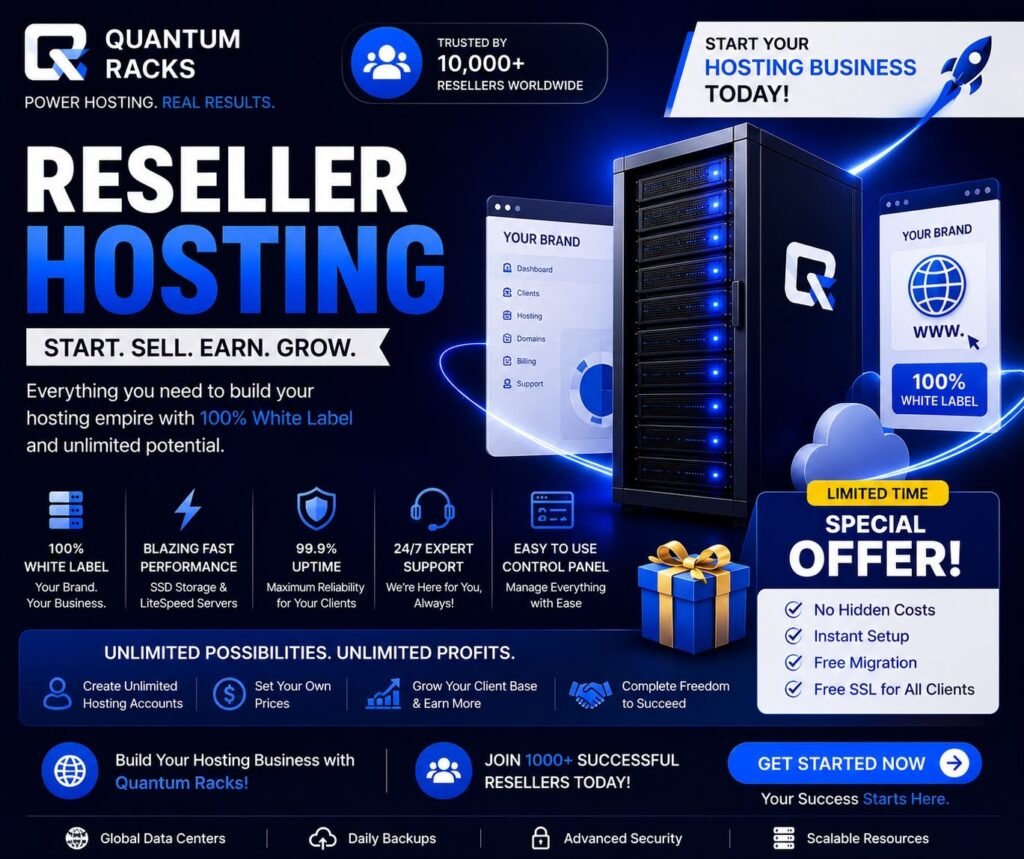
Starting a web hosting business has become easier than ever. You no longer need to purchase expensive servers, build a data center, hire a large technical team, or manage complex infrastructure from day one. With reseller hosting, you can purchase hosting resources from an established hosting provider and use those resources to offer web hosting services to your own customers.
For web developers, freelancers, digital agencies, entrepreneurs, IT consultants, and small businesses, reseller hosting can be an effective way to expand services and create recurring revenue.
Instead of simply building a website for a customer and ending the relationship after the project is completed, you can offer a complete package that includes domain registration, web hosting, SSL certificates, website maintenance, backups, and technical support.
In this guide, we’ll explain what reseller hosting is, how reseller hosting works, its benefits, important features to look for, who should use it, and how to start your own web hosting business with Quantum Racks.
What Is Reseller Hosting?
Reseller hosting is a web hosting service that allows individuals or businesses to purchase hosting resources from a hosting provider and then resell those resources to their own customers.
The hosting provider manages the underlying server infrastructure, while the reseller focuses on creating hosting packages, acquiring customers, managing accounts, setting prices, and building their brand.
For example, imagine you operate a web development agency.
A customer approaches you because they need a business website. You could provide only website development, or you could offer a complete digital package:
- Website design
- Website development
- Domain registration
- Web hosting
- SSL certificate
- Business email
- Website migration
- Backups
- Website maintenance
- Technical support
By adding hosting to your services, you can continue earning revenue from the customer after the website development project is finished.
This is one of the main reasons reseller hosting for web developers and agencies has become popular.
How Does Reseller Hosting Work?
The basic reseller hosting model is straightforward.
You purchase a reseller hosting plan from a hosting provider. The plan gives you access to a specific amount of storage, bandwidth, hosting accounts, and other resources.
You then divide those resources into your own hosting packages and sell them to customers.
Here’s how the process typically works.
1. Purchase a Reseller Hosting Plan
The first step is choosing a reliable reseller hosting provider.
Your reseller package determines the resources available to your business, such as storage, bandwidth, number of accounts, control panels, server technology, and other features.
Choose a plan based on your expected number of customers rather than simply selecting the cheapest package.
2. Create Your Own Hosting Packages
Once you purchase a reseller plan, you can create different hosting packages according to your customers’ needs.
For example:
Starter Hosting
Designed for personal websites, portfolios, blogs, and small websites.
Business Hosting
Suitable for small businesses and growing websites that require additional resources.
Professional Hosting
Designed for larger websites, professionals, agencies, and customers with higher resource requirements.
Premium Hosting
A higher-resource option for customers who need additional storage, bandwidth, and performance.
Creating multiple packages allows you to serve different customer segments without offering the same plan to everyone.
3. Create Customer Hosting Accounts
After creating your packages, you can create separate hosting accounts for your customers.
This makes it easier to organize multiple websites and manage resources individually.
A good reseller hosting platform should provide management tools that make creating and maintaining customer accounts simple.
4. Sell Hosting Under Your Own Brand
One of the biggest advantages of reseller hosting is white-label hosting.
With white-label reseller hosting, you can build your own hosting brand instead of prominently displaying the name of your infrastructure provider.
You can create your own:
- Business name
- Logo
- Website
- Hosting packages
- Pricing
- Customer portal
- Marketing strategy
- Support process
This allows you to build a professional hosting business around your own brand.
5. Manage Customers and Services
As your business grows, you’ll need to manage hosting accounts, billing, domains, support requests, resources, and renewals.
Tools such as WHM, cPanel, and WHMCS can make these tasks easier depending on your hosting setup.
Automation can be particularly valuable when you have dozens or hundreds of customers.
Why Choose Reseller Hosting?
Reseller hosting provides a practical entry point into the hosting industry because you can start without owning physical server infrastructure.
Instead of spending your initial budget on servers and networking equipment, you can concentrate on branding, marketing, customer acquisition, and support.
Here are some of the major benefits.
1. Start a Hosting Business With Lower Infrastructure Costs
Starting a traditional hosting company from scratch can be expensive.
You may need:
- Physical servers
- Networking equipment
- Data-center facilities
- Power infrastructure
- Cooling systems
- Network connectivity
- Security systems
- Monitoring systems
- Technical staff
- Backup infrastructure
Reseller hosting reduces much of this complexity.
Your hosting provider manages the underlying infrastructure, allowing you to focus on running and growing your business.
This makes reseller hosting particularly attractive to beginners and small businesses.
2. Build Your Own Hosting Brand
With white-label reseller hosting, you can create a hosting company under your own name.
You control how your customers experience the service.
You can decide your:
- Brand identity
- Website design
- Hosting plans
- Pricing
- Promotions
- Customer communication
- Support process
Instead of simply referring customers to another hosting company, you can make hosting part of your own service portfolio.
3. Create Recurring Revenue
One of the strongest reasons businesses choose reseller hosting is recurring revenue.
Website hosting is normally purchased as a monthly or annual service. Customers need to keep their hosting active as long as their websites remain online.
For a freelancer or agency, this creates an opportunity to transform a one-time website development project into an ongoing business relationship.
For example:
Website project → Hosting → Domain → SSL → Maintenance → Support
Each service can potentially contribute to long-term customer value.
4. Increase Revenue From Existing Customers
You don’t always need to find completely new customers to grow your hosting business.
If you’re already providing services such as:
- Web design
- WordPress development
- SEO
- Digital marketing
- E-commerce development
- IT consulting
you may already have customers who need reliable hosting.
Reseller hosting allows you to add hosting to your existing services.
5. Perfect for Web Developers and Agencies
Web developers frequently work with customers who need hosting.
Instead of telling customers to purchase hosting from a third-party company, developers can provide hosting as part of their service.
For example:
Website Design + Hosting + Domain + SSL + Maintenance
This provides customers with a more convenient experience while giving the developer another source of recurring revenue.
6. No Need to Manage Physical Servers
Server management can require significant technical knowledge and resources.
With reseller hosting, the provider handles the underlying infrastructure, hardware, networking, and many server-level responsibilities.
This allows resellers to spend more time on business development, marketing, customer support, and website services.
7. Easier to Scale Your Business
As your customer base grows, you can move to a larger reseller package or another hosting solution that better matches your requirements.
This makes reseller hosting suitable for businesses that want to start small and expand gradually.
Important Features to Look for in Reseller Hosting
Choosing a reseller hosting provider is an important decision.
The quality of the infrastructure you choose can directly affect the websites of your customers and, consequently, your reputation.
Before purchasing a reseller hosting plan, consider the following features.
NVMe SSD Storage
Storage technology can influence website performance and server responsiveness.
NVMe SSD storage provides fast storage performance and is particularly useful for websites that frequently access databases, files, images, and other resources.
Quantum Racks reseller hosting plans include NVMe SSD storage to provide a fast hosting environment for websites.
LiteSpeed Web Server
Web server technology can have a major impact on website performance.
LiteSpeed Web Server is widely used for high-performance websites and is especially popular among WordPress users because of its compatibility with caching technologies such as LiteSpeed Cache.
For resellers serving WordPress customers, LiteSpeed can be an important feature to consider.
cPanel Hosting
A hosting control panel makes it easier to manage websites and hosting services.
With cPanel hosting, customers can typically manage tasks such as:
- Domains
- Subdomains
- Email accounts
- Databases
- File management
- SSL certificates
- Backups
- Website settings
A familiar control panel can also reduce the learning curve for customers.
WHM Access
WHM, or Web Host Manager, is particularly useful for hosting resellers.
It allows you to manage multiple hosting accounts and configure packages.
Depending on your provider and plan, WHM can be used to:
- Create hosting accounts
- Create packages
- Manage customer resources
- Modify account settings
- Monitor accounts
- Manage domains
- Perform administrative tasks
For anyone planning to operate a hosting business, WHM can become an important part of daily operations.
WHMCS Support
As your customer base grows, manual billing and account management can become difficult.
WHMCS can help automate several hosting-business processes, including:
- Customer registration
- Invoicing
- Recurring billing
- Service management
- Hosting account provisioning
- Customer notifications
- Support management
Automation can save time and reduce repetitive administrative work.
Free SSL Certificates
SSL certificates encrypt communication between a website and its visitors.
Today, HTTPS is an important part of running a professional website.
Providing free SSL certificates can make your hosting packages more attractive and reduce the technical work customers need to perform themselves.
Backup Protection
Website data can be lost because of accidental deletion, software problems, security incidents, or configuration errors.
Reliable backups provide an additional layer of protection.
When comparing reseller hosting providers, check what backup system is included, how frequently backups are taken, and how restoration works.
DDoS Protection
Distributed Denial-of-Service attacks can send large amounts of unwanted traffic toward a server or website.
DDoS protection can help reduce the impact of certain attacks and improve overall infrastructure resilience.
Security should be a major consideration when choosing hosting infrastructure for your customers.
Reliable Uptime
Customers expect their websites to remain accessible.
Frequent downtime can damage your reputation and potentially affect your customers’ businesses.
When evaluating reseller hosting, consider:
- Network reliability
- Server monitoring
- Infrastructure quality
- Uptime commitment
- Backup systems
- Security measures
- Technical support
24/7 Customer Support
Technical issues can occur outside normal business hours.
If your customers depend on you for hosting, access to responsive technical support from your infrastructure provider can help you handle server-related problems more efficiently.
Reliable support can also help you provide a better customer experience.
Who Should Use Reseller Hosting?
Reseller hosting isn’t limited to traditional hosting companies.
Many different professionals can benefit from it.
Web Development Agencies
Web agencies can bundle hosting with website development and maintenance.
Instead of delivering a website and leaving the customer to manage hosting independently, agencies can provide a complete solution.
Freelance Web Developers
Freelancers can use reseller hosting to create an additional recurring income stream while providing clients with a convenient hosting service.
Digital Marketing Agencies
Marketing agencies often work with businesses that need websites, domains, email, and hosting.
Adding hosting to their services can help create a more complete digital solution.
Entrepreneurs
Entrepreneurs interested in launching a small hosting company can use reseller hosting as a starting point.
It allows them to concentrate on acquiring customers and developing their brand rather than building server infrastructure from scratch.
IT Consultants
IT consultants can offer website hosting as part of broader technology services.
WordPress Professionals
WordPress developers and maintenance providers can host client websites and combine hosting with maintenance, updates, security, and optimization.
Existing Hosting Businesses
Existing hosting businesses can also use reseller plans to expand their service offerings or enter new markets.
Reseller Hosting vs Regular Web Hosting
Understanding the difference between regular web hosting and reseller hosting is important.
Regular web hosting is primarily designed for hosting your own website or websites.
Reseller hosting is designed for businesses or individuals who want to manage multiple customer hosting accounts and potentially sell hosting services.
| Feature | Regular Web Hosting | Reseller Hosting |
|---|---|---|
| Host your own website | Yes | Yes |
| Host multiple websites | Yes | Yes |
| Create customer accounts | Limited | Yes |
| Create hosting packages | Usually no | Yes |
| WHM management | Usually no | Yes |
| White-label branding | Usually no | Often available |
| Sell hosting to customers | Not designed for it | Yes |
| Recurring hosting business | Limited | Yes |
| Suitable for agencies | Sometimes | Yes |
| Suitable for hosting businesses | No | Yes |
If you only need hosting for your personal website, blog, or business website, regular web hosting may be enough.
However, if your goal is to sell web hosting to customers, reseller hosting is a much better fit.
How to Start a Reseller Hosting Business
Starting a hosting business doesn’t have to happen all at once.
You can begin with a small target audience and expand as you gain experience.
Step 1: Choose Your Target Audience
The first step is deciding who you want to serve.
Possible audiences include:
- Small businesses
- Startups
- Bloggers
- Local businesses
- Freelancers
- Online stores
- WordPress users
- Web design agencies
- Digital entrepreneurs
A clearly defined target audience can make your marketing strategy more effective.
For example, instead of marketing yourself as a hosting provider for everyone, you could position your brand as:
Affordable WordPress Hosting for Small Businesses
or:
White-Label Hosting for Web Design Agencies
A specific positioning can help customers understand why they should choose your service.
Step 2: Choose a Reliable Reseller Hosting Provider
Your hosting provider is the foundation of your business.
Compare providers based on:
- NVMe storage
- Server performance
- LiteSpeed
- cPanel
- WHM
- WHMCS compatibility
- Security
- Backups
- DDoS protection
- Uptime
- Support
- Scalability
- Pricing
Don’t choose a provider based only on price.
A cheap infrastructure provider that frequently experiences performance or support problems can create problems for your own customers.
Step 3: Create Your Hosting Brand
Choose a memorable business name and create a professional brand identity.
You should consider:
- Domain name
- Logo
- Website
- Brand colors
- Hosting packages
- Pricing
- Support channels
- Terms and conditions
- Privacy policy
- Refund policy
Your hosting website should make it easy for visitors to understand what you offer.
Step 4: Create Hosting Packages
Create several packages based on customer requirements.
For example:
Starter Hosting
For blogs, portfolios, and personal websites.
Business Hosting
For small business websites and professional websites.
Professional Hosting
For growing websites, developers, and agencies.
Premium Hosting
For customers who need more resources and performance.
Don’t create too many plans at the beginning. Three or four clearly differentiated packages are usually easier for customers to understand.
Step 5: Set Your Pricing
Your pricing should cover more than just the reseller hosting cost.
Consider:
- Infrastructure costs
- Billing software
- Payment processing
- Marketing
- Customer support
- Website costs
- Business expenses
- Taxes
- Future infrastructure upgrades
Your goal should not simply be to offer the lowest price.
Instead, communicate the value customers receive through performance, support, reliability, security, and convenience.
Step 6: Add Hosting to Your Existing Services
If you already provide website services, reseller hosting can be introduced as an additional service.
For example:
Website Design → Hosting → Domain → SSL → Maintenance
This approach can increase the lifetime value of existing customers.
Step 7: Promote Your Hosting Business
Once your website and hosting packages are ready, start marketing your service.
You can use:
- Search engine optimization
- Google Ads
- Social media marketing
- Content marketing
- Email marketing
- Referral programs
- Affiliate marketing
- Local business outreach
Content marketing can be particularly useful for hosting businesses.
You can publish articles about:
- How web hosting works
- WordPress hosting
- Website speed
- SSL certificates
- Website security
- Domain names
- Cloud hosting
- VPS hosting
- Website backups
- Reseller hosting
Helpful content can attract people who are already searching for hosting-related solutions.
How to Make Your Reseller Hosting Business Successful
Purchasing a reseller hosting plan is only the beginning.
Building a successful hosting business requires more than server resources.
Focus on Customer Experience
Your customers should be able to easily:
- Purchase hosting
- Make payments
- Access their account
- Manage websites
- Contact support
- Renew services
- Upgrade plans
A simple customer experience can help improve retention.
Provide Fast and Helpful Support
Hosting customers often contact support when their website is not working.
Clear communication is extremely important.
Even when the technical issue is outside your direct control, keeping the customer informed can improve trust.
Create Useful Content
Publish tutorials and guides that answer common customer questions.
For example:
How to Install WordPress
How to Connect a Domain to Hosting
How to Enable SSL
How to Create a Business Email
How to Improve WordPress Website Speed
These articles can support both your customers and your SEO strategy.
Monitor Your Resources
As your customer base grows, monitor resource usage.
If your customers consistently use more CPU, RAM, storage, or bandwidth than expected, you may need to upgrade your reseller plan or move to a larger infrastructure solution.
Planning for growth prevents performance problems later.
Why Choose Quantum Racks for Reseller Hosting?
Quantum Racks provides reseller hosting solutions for developers, freelancers, agencies, entrepreneurs, and businesses that want to build or expand a hosting business.
The reseller hosting service includes features designed to help you manage multiple hosting accounts and offer professional hosting services to customers.
Depending on the plan, key features include:
- NVMe SSD storage
- Premium bandwidth
- cPanel
- WHM
- WHMCS support
- LiteSpeed servers
- Free SSL
- White-label hosting
- CloudLinux
- CageFS
- MailChannels
- Backup options
- DDoS protection
- 24/7 support
- Scalable hosting resources
These features can help reduce the technical complexity of running a hosting business while allowing you to focus on branding, marketing, customer acquisition, and support.
For a freelancer, reseller hosting can be a way to add hosting to existing website-development services.
For an agency, it can help create a recurring revenue model around existing clients.
For an entrepreneur, it can provide a starting point for building a dedicated hosting brand.
Explore Quantum Racks Reseller Hosting to learn more about the available plans and features.
Frequently Asked Questions About Reseller Hosting
Is reseller hosting good for beginners?
Yes. Reseller hosting can be suitable for beginners because the infrastructure is managed by the hosting provider. However, you should still understand basic concepts such as domains, DNS, hosting accounts, SSL, email, backups, and customer support.
Can I sell hosting under my own brand?
Yes. Many reseller hosting solutions provide white-label functionality, allowing you to market hosting under your own business name.
Do I need my own server for reseller hosting?
No. One of the primary benefits of reseller hosting is that you don’t need to purchase or maintain your own physical server.
Can web developers use reseller hosting?
Absolutely. Web developers can bundle hosting with website development, domain registration, SSL, maintenance, and support.
Can I make money with reseller hosting?
Reseller hosting can provide an opportunity to generate recurring revenue, but profitability depends on factors such as pricing, customer acquisition, infrastructure costs, support costs, retention, and the value of additional services you provide.
Is reseller hosting suitable for agencies?
Yes. Agencies can use reseller hosting to provide clients with a complete website solution and create recurring revenue from hosting and maintenance services.
What is white-label reseller hosting?
White-label reseller hosting allows you to sell hosting services under your own brand rather than presenting yourself primarily as a customer of another hosting provider.
What is the difference between reseller hosting and VPS hosting?
With reseller hosting, the primary goal is usually to create and manage customer hosting accounts using infrastructure provided by a hosting company.
A VPS gives you a virtual server environment with greater control over server configuration, but it generally requires more technical knowledge and server management.
Final Thoughts
Reseller hosting is one of the simplest ways to enter the web hosting industry without investing in your own physical server infrastructure.
Whether you’re a freelance web developer, digital agency, WordPress professional, IT consultant, or entrepreneur, reseller hosting can help you turn hosting into an additional service and potential recurring revenue stream.
The key is to choose reliable infrastructure, create clear hosting packages, develop a professional brand, provide responsive customer support, and consistently deliver value to your customers.
You don’t need to build a data center before starting a hosting business.
You need a reliable reseller hosting platform, a clear business strategy, a professional website, and a commitment to serving your customers.
With the right approach, you can start small, gain customers, improve your services, and gradually scale your hosting business.
Ready to start your own hosting business?
Explore Quantum Racks Reseller Hosting and choose a plan that fits your business requirements.
Build your hosting brand. Serve your customers. Grow your recurring revenue with Quantum Racks.
Leave a Reply